




Facial Hair and Respiratory Protection: A Prickly Issue
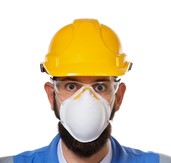 Facial hair and tight-fitting respiratory protective equipment (RPE) is a perennial issue for occupational hygienists, health and safety advisers and fit testers all over the country, and in all industries where such protection is required. Those with facial hair are, it seems from day to day practice, increasingly unwilling to part with their stubble or beards, citing reasons like, “My partner likes me this way” or “My children wouldn’t recognise me if I shaved”. Conversely, operatives can regularly be seen on site wearing a mask with clear stubble or, in some cases, a full beard, and when asked “What is wrong with your mask?”, they are often quick to identify the issue, but seemingly happy to continue in their work.
The problem with facial hair is that its density, length and even the thickness of individual hairs can vary from person to person, with a day’s stubble providing a good fit in qualitative testing for one person and a poor fit for another. Hairs between the facepiece edge and the skin introduce small gaps that provide an inlet for air – this means that when the wearer breathes in, creating negative pressure inside the facepiece, air rushes in via the route of least resistance. With a tight seal, this would be through the filters, but if there is a sufficient gap caused by poor fit or facial hair, the filters will be bypassed, causing contaminated air to enter the person’s airway.
The Health and Safety Executive produced a research report (RR1052) in 2015 examining the effect of facial hair on mask fit and found variable results that were dependent both on the person and the specific mask being used; the key finding though was that inward leakage could be observed within 24 hours of shaving in some participant/mask combinations, bolstering the long-held view that wearers should be clean shaven. The report goes on to conclude that its findings support the definition of “unshaven” in EN529 being hair not shaved within the previous eight-hour period.
The usual approach to providing tight-fitting RPE has been to make it a requirement of being ready for work, in the same way that a construction worker presenting without a hard hat or safety boots would not be allowed on site. The legal basis for this would be, other than any individual contractual provisions, the requirement of s.2(1) of the Health and Safety at Work etc. Act 1974 (HASAWA) that an employer “ensure, so far as is reasonably practicable, the health, safety and welfare at work of all his employees” and the general duties of employees laid out in s.7 of that act to “take reasonable care” of their own health and safety. This, coupled with the variety of HSE guidance documents (e.g., HSG53 and INDG479) that inform employers of the need for a clean shave to ensure fit, was felt by many to provide a solid base from which employees could be told that they needed to be clean shaven.
The exceptions to this are beards worn for religious reasons, such as by followers of Sikhism, and employees who experience an exacerbation of a skin condition when shaving; these are covered by the provisions of the Equality Act 2010 where religion and disability are protected characteristics.
A recent eBulletin from the Health and Safety Executive in September 2022 has cast some doubt on this, stating the following:
“You should note that under health and safety law, employers cannot require workers to be clean shaven; this is because alternative RPE to tight fitting respirators are available and can be used instead.”
Whilst alternatives are indeed available, namely in the form of powered air-purifying respirators (PAPRs), these are approximately £500 per unit, with some extending upwards of £1000; compared with a £20 P3-rated half-mask, this is a sizeable difference. Whilst many employees would probably prefer a PAPR, depending on the use scenario the financial cost may be significant. There is an argument to be had that such units, if properly cared for, may save money in the longer term, as they require fewer filter changes and regular face fit testing can be discarded. This may be true in scenarios where operatives use RPE every day for specific tasks, such as manufacturing, but in industries like construction where the workforce can be fluid and transient, the attrition of budgets from PAPR units that left the site or project with the employee is likely to be significant if not policed thoroughly.
Where does this leave employers, and those of us that advise them? If an occupational hygiene report were to contain reference to this short sentence from the HSE, which was buried in a monthly bulletin and not provided on their RPE information pages, the employer receiving this might reasonably panic as they begin to count their RPE wearers on one hand whilst multiplying this number by £500 or more.
But if the current way of looking at exceptions to tight-fitting RPE continues, what of the other reasons that people may wear beards that some might also consider protected by the Equality Act. If someone grew a beard to cover facial scarring, which wouldn’t be exacerbated by shaving but could have a detrimental effect on the person’s mental health if exposed to the world, would this be reasonable? Or a transgender male who considers a beard part of his previously repressed gender identity – should he be forced to shave? Would a supervisor or manager feel morally and legally secure asking a woman with polycystic ovary syndrome who has chosen to embrace the facial hair that her condition causes to shave it? With the ever-increasing focus on mental health at work, these may be real problems for employees.
In short, there is no simple answer to this issue. The recent update from the HSE’s eBulletin has, if anything, raised more questions rather than clarifying the issue and creating a level field, which seemed to be its intention. And, in the absence of further information regarding the rationale behind it, or even its presence on their main website, the situation remains muddied. The issue of beards and tight-fitting RPE has often been considered simple, but perhaps it is only deceptively so. What is clear is that these issues may need to be considered more sensitively.
The main reason for the use of RPE is to reduce exposure to as low a level as is reasonably practicable; however, in occupational hygiene, we regularly see workplaces where it is being used as the main control measure. The problem with this approach, other than it not following the hierarchy of control, is that issues with fit become compounded because the RPE is now required to do the job, rather than being one part of the overall exposure control strategy. For any workplaces that are considering upgrading to PAPR systems, this is a good time to review controls and determine whether different materials can be used or engineering methods installed to reduce exposure. Engaging an occupational hygiene consultant at this stage can greatly assist with this, helping to ensure that the new controls are effective from installation, rather than paying for hygiene input afterwards to test their effectiveness and finding out that changes are needed.