




Our Pedigree
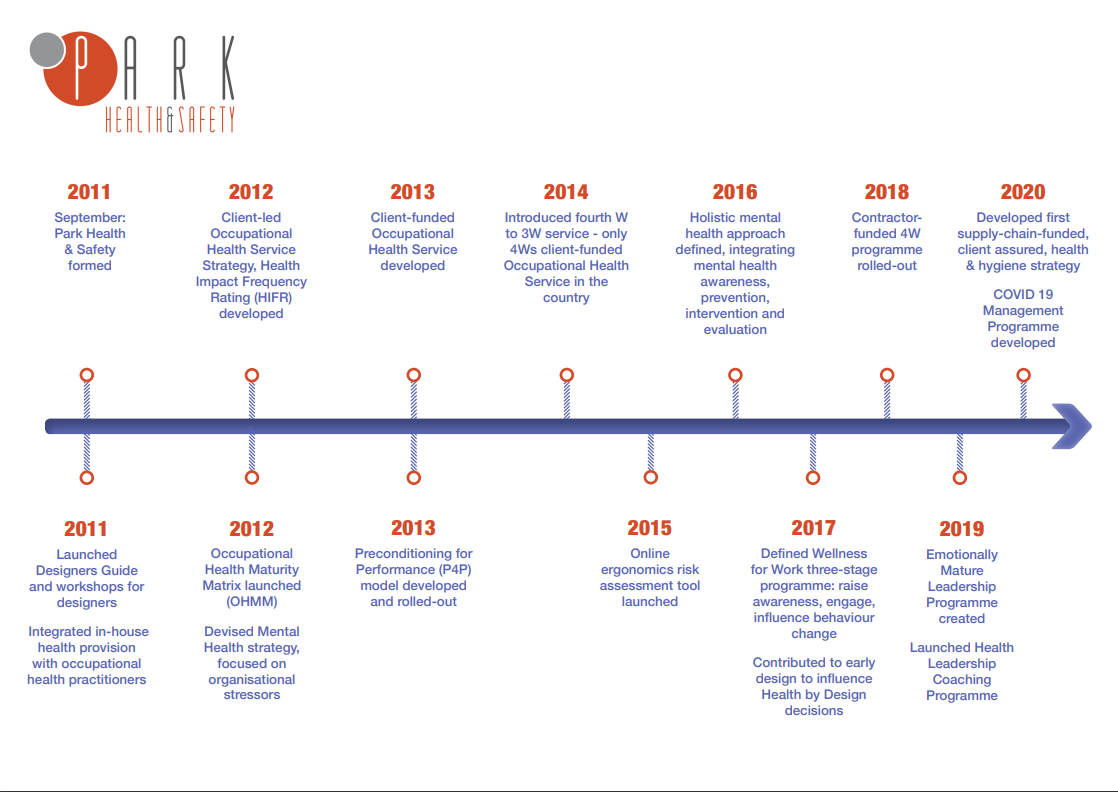
Our Journey so far
Park Health & Safety
As Managing Partner, Karen Baxter is at the helm of Park Health & Safety and, in the eight short years since its inception, she has seen it grow into a successful business, with an enviable client list and a well-deserved reputation for excellence and innovation.
Recognised as pioneers in the health & wellbeing sector and credited for bringing about wholesale change in industry-thinking, the Park team is on a mission to get people talking about health in the same way they do about safety, based on a systematic and measurable approach.
It’s not just about fixing accidents and illness when they occur at work, it’s about preventing them in the first place. It really is as simple as that.
3 W’s
The first germ of an idea for Park began during early preparations for the London 2012 Olympics. Given the space to innovate and with the support of colleagues, key members of the team were able to articulate a framework for the Olympic build which was based on three Ws: workplace, worker and wellbeing. Simple in its design but profound in its impact.
Adopting this fundamental step-change in approach had a significant bearing on every aspect of the Olympic-build, contributing to the foundation for the first Games to be delivered without a fatality.
With this shared vision and tangible evidence that the framework had added value in the Olympic-build, the founding partners knew they wanted to continue to deliver improvements in the workplace based on these three initial principles.
It was at this point that Park as a concept really started to take shape. Establishing Park provided the team with the autonomy to define a strategic direction for their thinking. This enabled them to furnish clients with an effective and meaningful methodology, leading to better health for workers and the added benefit of cost-savings for management.
In order to influence wider perceptions on the value of creating a healthy environment for workers rather than putting the onus on the individual to adopt a healthy lifestyle, the Park team recognised it would have to develop a range of practical and credible tools to underpin and, therefore, warrant industry confidence in its approach.
Occupational Health Maturity Matrix and Health Impact Frequency Rating
By applying health concepts to traditional safety models, the team developed an extensive toolkit. This included the Occupational Health Maturity Matrix (OHMM), which measures the application of the 3Ws principles and demonstrates their tangible impact to management. Another useful engagement and education tool to be developed by Park was the Health Impact Frequency Rating (HIFR) which gave Park a unique opportunity to engage workers on their health.
Traditionally, workers steer clear of reporting any medical issues to a ‘health official’ as they perceive this will result in an absence from work and loss of pay. However, using a measure such as the HIFR clearly demonstrates how the responsibility of creating a healthy and safe environment sits with management not the individual and building trust and openness around health matters relevant to work.
Health by Design
As Park emerged from the London Olympics, armed with a persuasive toolkit and a legacy of achievement, the team recognised that in order to make further inroads into industry thinking, it would be vital for health to be included at the planning stage of any project.
Fortunately, they were joined on subsequent projects with like-minded individuals who shared their belief that the way forward was to deliver a more comprehensive approach to health and wellbeing, embedding principles from the outset of a build rather than layering them onto existing ways of working.
Early success was achieved when the team implemented the Designers Guide for Health in commissions for large industry contractors, such as Crossrail and Tideway. Park was engaged at a much earlier stage in the planning process and this resulted in those same high standards, set at the Olympics, being adopted on sites, securing better health outcomes for the workers.
Health in the Operational Line and a 4th W
Park believes health must be on the agenda in the same way that safety is considered in the operational line. It has to be a fundamental part of the early planning process. Park has been able to steer management on large infrastructure contracts to go ‘back to basics’ applying the 3Ws framework to highlight how agreed industry standards are not being met. Park works with customers to enable them to reach those standards on a daily basis, not just in paper-based risk assessments.
As the 3Ws grew in prominence and credibility with various contractors, it also afforded Park the opportunity to further progress the framework into the 4Ws, adding a dimension for “wider community.” In 2014, this was taken-up by the Battersea Development Company which enabled the team at Park to create a programme of healthcare-related services for the local community which included blood pressure testing, defibrillator training and stop-smoking classes. Of course, not all clients have the wherewithal to engage Park to deliver the fourth ‘W’ but the overall simplicity of the framework allows a flex between the two formats as needed.
Mental Health Management and Health Leadership
With a long-term vision to influence organisations to improve people’s physical health and psychological wellbeing, Park recognises that it is critical it has the expertise to provide a comprehensive service to clients.
While other providers bring in resource as it is needed, Park prides itself in having its own inhouse specialists who understand and believe in Park’s ethics and ways of working. In 2013, it expanded by employing a number of occupational health clinicians to complement its existing core team of hygienists.
Having a mix of skills inhouse sets Park apart from other providers. Its colleagues bring their own expertise and they further contribute to the business knowledge base and stretch its thinking. The team also draws upon in-house expertise in the areas of mental health and ergonomics to demonstrate to clients the relevance of psychological wellbeing as well as physical health and the connection between the two. This is where Park sees itself adding value in the future, aiming to put mental health firmly on the corporate agenda as it did with workplace health.
Park believes that in order to address workplace stress, rather than simply focusing on the individual, the causes of that stress must be investigated so appropriate action can be taken to
protect other workers from experiencing the same challenges. By identifying and intervening early, it is possible to pre-empt the development of a longer-term issue . This is beneficial to the employee, the employer and society as a whole.
While many employers have responded to the current spotlight on mental health by offering training for mental health first-aiders, Park aims to realise the benefits of a more holistic and organisation-wide focused approach. This has never been more critical than it is now, with the advent of the Coronavirus pandemic, which is already having a significant effect on workers’ psychological wellbeing.
Where to Next
From strong foundations, with significant expertise and well-established and proven health & wellbeing models, Park aims to continue to help build a strong and resilient industry and workforce to achieve the shared common goal to have healthy workers, in healthy workplaces, making healthy lifestyle choices.